If you are looking for one of Cape Coral’s most compelling luxury plays, the riverfront corridor deserves a close look. Buyers and property owners here are not just chasing a waterfront address. They are weighing lot scale, open-water views, boating access, and the impact of major public and private investment across South Cape. This is where understanding the details can help you protect value and spot real upside. Let’s dive in.
Why the Cape Coral Riverfront Stands Out
The Cape Coral riverfront corridor includes the south-Cape waterfront around the Yacht Club, Jaycee Park and Beach Parkway, and Bimini Basin south of Cape Coral Parkway. City materials describe South Cape as the historic core of Cape Coral, and the Community Redevelopment Agency says its mission is to enhance the district and create a vibrant urban village. You can see that vision in the city’s overview of South Cape redevelopment opportunities.
For luxury buyers, that matters because estate value is rarely tied to a house alone. It often reflects the trajectory of the surrounding corridor. In South Cape, the mix of waterfront access, redevelopment momentum, and public reinvestment creates a stronger long-term story than an isolated luxury parcel in a quieter pocket.
South Cape Momentum Is Real
One of the clearest signals is Bimini Basin East, a 22-acre city-backed redevelopment site south of Cape Coral Parkway between Tarpon Court and Coronado Parkway. The city lists it as Mixed-Use Bimini, with a maximum density of 125 dwelling units per acre, maximum height of 160 feet, city utilities, and saltwater access, according to the city’s Bimini Basin East development information.
That project does not stand alone. The city says the broader South Cape CRA already includes more than 60 restaurants and attracts more than 250,000 annual visitors. It also highlights Bimini West, a mixed-use waterfront project, and Bimini Square, a $100 million waterfront development with 218 luxury apartments, Lee Health outpatient space, a 25-slip marina, and phased retail and dining openings, as noted on the CRA development opportunities page.
For you, this creates an important framework. Luxury real estate tends to perform best when it sits near durable lifestyle drivers, not just scenic water. In this corridor, those drivers include dining, marina activity, walkable mixed-use development, and a clear public commitment to the area.
Public Waterfront Investment Supports Value
The riverfront story is also being shaped by major public projects. Jaycee Park is being rebuilt as a riverfront destination with a boardwalk overlook, inclusive playground, splash pad, bandshell, and accessibility upgrades, according to the city’s Jaycee Park project page.
The Yacht Club Community Park renovation is also moving forward after securing key state and federal permits. The plan includes new docks, a relocated boat ramp, seawall replacement, dredging, and additional marina slips, as outlined by the city’s Yacht Club Community Park updates.
Add in the Bimini Basin Mooring Field project, which includes 15 mooring buoys, a dinghy dock, pump-out station, and captain’s walk, and the boating-first identity of the corridor becomes even clearer. For luxury owners, that kind of public investment can improve usability, reinforce destination appeal, and support the character that draws high-end buyers in the first place.
Lot Scale Shapes Estate Potential
Not every waterfront lot in Cape Coral offers the same estate potential. The city’s zoning code sets a minimum lot area of 10,000 square feet in R-1 districts and 40,000 square feet in RE districts, while Mixed Use Bimini has its own development standards including heights up to 160 feet and certain reduced setbacks, based on the city’s zoning districts document.
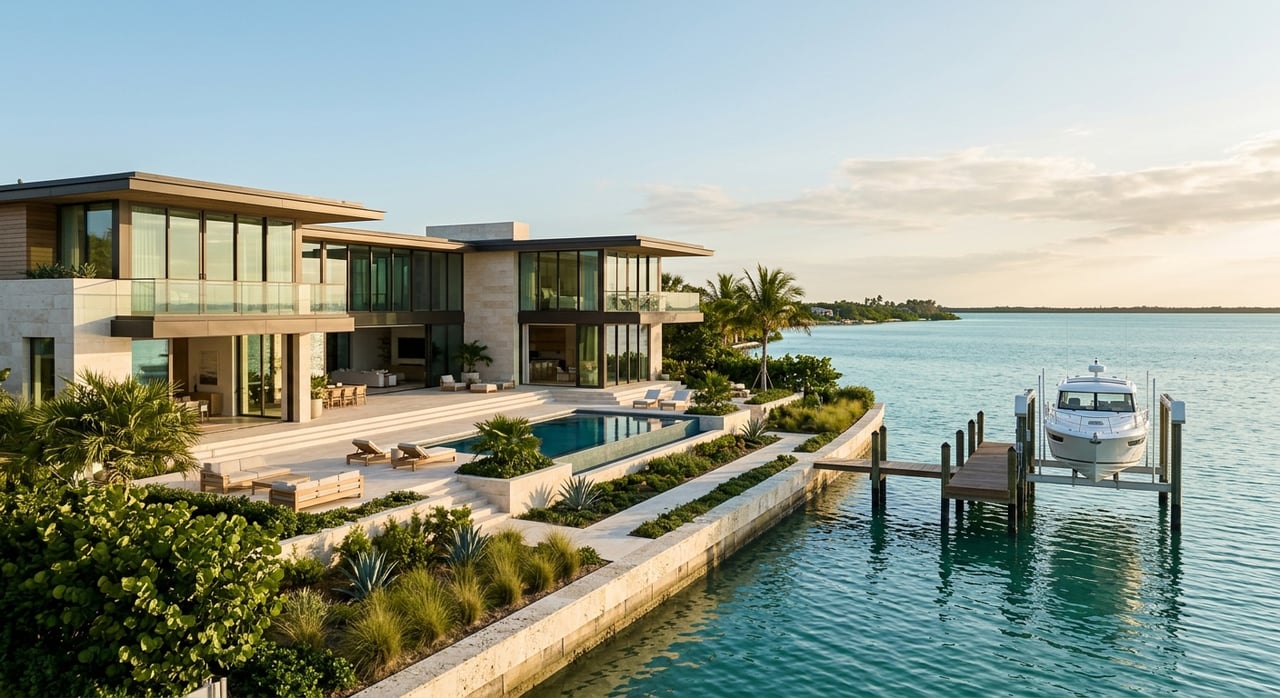
That baseline helps explain why the riverfront corridor can feel so different from a standard subdivision lot pattern. Recent examples in the market show what buyers are really responding to. One riverfront lot at 5982 SW 1st Ct was marketed at 0.36 acres with 265 linear feet of new seawall and southern and eastern exposure, while a Riverside Drive property was advertised with 140 feet of Caloosahatchee frontage and a large custom-estate setting, according to current listing examples from Compass and Compass riverfront marketing.
A separate Nautilus Drive estate spans 0.41 acres and 6,588 square feet with direct sailboat access. Taken together, these examples show the kind of footprint that starts to support a true estate-style product rather than a typical waterfront home.
Frontage and Exposure Matter
If you are evaluating riverfront property for a teardown, custom build, or long-term hold, frontage may be one of the most important clues. An oversized pie-shaped lot at 218 Bayshore Drive was described as having 158 linear feet of waterfront and southwest rear exposure, while another Riverside Drive listing was positioned as one of the largest riverfront lots in Cape Coral, based on current listing language from Coldwell Banker and Compass.
Exposure is another meaningful factor. Current listing descriptions repeatedly highlight southern, southeastern, or southwest rear exposure. While that is not a formal appraisal rule, it does suggest that buyers value natural light, sunset orientation, and broad open-water sightlines right alongside dock utility.
Riverfront vs Premium Canal-Front
Many buyers ask whether direct riverfront is always the better choice. In practice, the answer depends on how you use the property.
Riverfront homes usually win on legacy views and open-water presence. They can also offer frontage that is difficult to replicate elsewhere. For buyers who want a statement setting, that visual experience often becomes a major part of the property’s value.
Premium canal-front can still be highly competitive, especially when the canal is wide, bridge-free, and close to the river. One current lot on Cocoa Court is a 0.28-acre buildable site on a 200-foot-wide canal with southern exposure, a new elevated seawall, no bridges or locks, and a reported 10-minute run to open water, according to a current Zillow listing example.
Bridge clearance is a major consideration in this part of the market. Lee County notes that both the Midpoint Memorial Bridge and the Cape Coral Bridge have 55-foot vertical clearance, which is why true bridge-free riverfront or very low-profile sailboat-access sites can command extra attention for larger vessels, based on Lee County facility information.
The practical takeaway is simple:
- Riverfront often offers stronger open-water views and legacy frontage
- Premium canal-front can offer protected docking, easier maneuverability, and in some cases newer construction
- Bridge-free access matters more as vessel height and boating demands increase
Boating Infrastructure Adds to the Lifestyle
This corridor is not just about private docks. The surrounding public boating network adds another layer of utility. The city says Rosen Park includes two 30-by-60 boat ramps, 57 trailer spaces, 31 vehicle spaces, 19 wet slips for vessels up to 40 feet, and river access about 11.2 statute miles from the Sanibel Causeway Bridge.
When you combine Rosen Park with the Yacht Club improvements and the Bimini Basin mooring field, the corridor reads as a mature waterfront ecosystem. That can be meaningful for both lifestyle buyers and owners thinking about future marketability.
Diligence Is Critical on Waterfront Estates
Luxury upside on the riverfront comes with real diligence requirements. The city identifies the Caloosahatchee River among the areas most susceptible to storm surge and advises the use of flood-resistant materials below base flood elevation plus one foot where feasible. It also notes that repairs in special flood hazard areas require permits and substantial-improvement review, as explained on the city’s flood protection guidance page.
That means you should never evaluate a waterfront parcel on appearance alone. Before moving forward, it is wise to understand whether the site may need seawall work, dock work, dredging, fill, grading, or elevation-related upgrades.
Permitting can also be complex. The city’s own Yacht Club process shows how waterfront improvements may involve design revisions, seawall work, dredging, and state or federal review. For a private buyer or seller, that does not mean a project is not worth pursuing. It means the right planning team matters.
How to Evaluate a Riverfront Opportunity
If you are comparing properties along the Cape Coral riverfront, focus on a few core questions:
- How much water frontage does the parcel actually offer?
- Is the boating path truly bridge-free, or just quick to the river?
- Does the property need seawall, dock, dredging, or fill work before design begins?
- Is the parcel located near South Cape investment catalysts like Bimini East, Bimini Square, Jaycee Park, or the Yacht Club?
- Does the lot size support your plan for a custom estate, teardown, or compound-style build?
These questions help separate a beautiful listing from a strong luxury asset.
What the Market Context Suggests
Broad averages do not tell the whole story in this segment, but they do offer useful context. A January 2026 MLS-based market report showed Yacht Club single-family homes at an average closed price of $712,683 and Tarpon Point Marina condos at $1,099,733 over the prior 12 months, according to the January 2026 market report.
Current riverfront trophy listings sit well above those broad averages. That gap reinforces an important point: the most relevant comparison for a luxury riverfront estate is not the entire Cape Coral market. It is the narrower luxury waterfront band where frontage, boating characteristics, and redevelopment context drive pricing.
Why This Corridor Appeals to Luxury Buyers
The best opportunities along the Cape Coral riverfront appear to fall into three buckets. First, true riverfront parcels with oversized frontage and open-water views. Second, wide no-bridge sailboat-access canal lots near the river. Third, properties within or near the South Cape mixed-use catalysts that are reshaping the surrounding district.
For buyers, that mix can support a compelling long-term ownership case. For sellers, it highlights why precise positioning matters. And for anyone considering a custom build or major remodel, it shows why lot quality and entitlement context should guide the decision just as much as the home itself.
If you want experienced guidance on buying, selling, or evaluating a waterfront lot or estate in Cape Coral, Potter Trinity offers a high-touch, consultative approach backed by local market knowledge, builder insight, and a steady process designed to give you peace of mind.
FAQs
What makes Cape Coral riverfront property different from standard waterfront lots?
- Riverfront property in this corridor can offer larger lot scale, longer waterfront frontage, broader Caloosahatchee views, and stronger estate-style potential than a typical interior canal lot.
What should you check before buying a Cape Coral riverfront lot?
- You should confirm frontage, boating access, bridge clearance, flood and storm-surge considerations, and whether the site may need seawall, dock, dredging, fill, or permitting work before building or remodeling.
How does South Cape redevelopment affect riverfront property?
- City-backed projects like Bimini Basin East, Bimini Square, Jaycee Park, the Yacht Club renovation, and the Bimini Basin mooring field add momentum, public investment, and lifestyle appeal to the surrounding corridor.
Is premium canal-front property in Cape Coral still worth considering?
- Yes. Wide, no-bridge sailboat-access canal lots near the river can offer strong boating utility, protected docking, and attractive build opportunities even if they do not have direct riverfront views.
How important is bridge clearance for Cape Coral luxury boating properties?
- It is very important for larger vessels, since the Midpoint Memorial Bridge and Cape Coral Bridge both have 55-foot vertical clearance, making true bridge-free access especially valuable for some buyers.