If your weekends live on the water, your Cape Coral address should match your boat. The biggest choice for serious boaters is simple on paper but complex in practice: riverfront on the Caloosahatchee or a Gulf‑access canal. Each option changes how your boat rides at the dock, how fast you reach open water, and what draft you can run with confidence.
In this guide, you will compare wake exposure, travel times, depth and draft realities, and typical dock setups. You will also get a quick calculator to estimate run times and a buyer checklist you can use during showings. Let’s dive in.
Riverfront vs canals: what it means
Riverfront properties sit on the Caloosahatchee River, a broad navigation corridor with commercial and transient traffic. The river offers more open water and turning room, along with stronger current and more wake exposure.
Gulf‑access canals are residential canals that connect to open water routes leading to Matlacha Pass or San Carlos Bay, then out to the Gulf of Mexico. These canals vary by width, depth, and traffic patterns. Interior canals tend to be the most protected.
Why this matters to you: exposure, depth, and distance are different in each setting. You can confirm official channel locations and aids to navigation on NOAA nautical charts and tide data through NOAA Tides & Currents before you tour docks or book surveys.
- Review official channel locations on NOAA nautical charts: NOAA Nautical Charts
- Check predicted tides and currents: NOAA Tides & Currents
Wakes and exposure at your dock
Riverfront realities
- Expect more frequent and larger wakes from tugs, barges, ferries, and faster powerboats. The river is a main corridor.
- Wind has more fetch across the river, which can create short‑period waves compared with interior canals.
- Current and tidal exchange are stronger. You will feel it when docking, tying off, and during storms.
- Docks need heavier pilings, robust fendering, and stronger tie‑offs to handle dynamic loads.
Canal experience
- Residential canals are generally calmer with less fetch. Wakes are smaller, especially away from canal mouths.
- Traffic and wakes increase near main cuts, public ramps, or marina clusters.
- Interior canals provide the most protection. They are often comfortable for small skiffs and bay boats.
Seasonal nuance
- Wind direction, winter tourist season, and event weekends can spike boat traffic and wake activity.
- Storm surge is a separate risk class. Seawalls and docks should meet local hurricane standards in both settings.
Travel time to open water
What sets your time
- Exact location in Cape Coral sets your route options.
- Your vessel’s cruise speed in knots and any speed zones will define pace.
- Current on the Caloosahatchee can change speed over ground, especially for slower boats.
- Night runs, narrow canals, and bridge clearance checks can add time.
Routing notes that matter
- Western and central Gulf‑access canals often provide shorter routes to Matlacha Pass or San Carlos Bay.
- Riverfront lots have direct river access but can require longer transits to reach the pass or Gulf, depending on your destination.
A simple calculator you can use
- Formula: Travel time in hours = Distance in nautical miles ÷ Cruise speed in knots.
- To convert to minutes, multiply by 60.
Examples you can copy and adjust:
- If your dock is about 6 nautical miles from your preferred pass and you cruise at 18 knots: 6 ÷ 18 = 0.33 hours, about 20 minutes.
- If you run a trawler at 8 knots for the same 6 nautical miles: 6 ÷ 8 = 0.75 hours, about 45 minutes.
Use a conservative distance and assume some time for no‑wake zones and channel congestion.
Depth and draft: what to verify
What to measure at the property
- Depth at the dock and along the canal at mean low water. Ask for recent soundings.
- Depth variation between low and high tide, and evidence of shoaling.
- Depth alongside the seawall versus at a floating dock. Floating docks help with boarding but do not change channel depth.
Cross‑check channel markers and baselines with NOAA Nautical Charts and tide predictions through NOAA Tides & Currents.
Draft implications by boat type
- Shallow‑draft skiffs and small bay boats usually do well in protected canals.
- Moderate‑draft center consoles and many trailerable boats are commonly supported in Gulf‑access canals with adequate depth.
- Deeper‑draft power yachts and sailboats need well‑maintained channels and ample turning room. Select riverfront slips or marinas often work better if depth is verified.
Dredging and maintenance
- Some canals are dredged on a schedule. Confirm who is responsible for maintenance and when it was last completed.
- Lack of maintenance can reduce usable depth quickly. Build dredging responsibility into your ownership cost analysis.
Dock setups, permits, and upkeep
Common configurations in Cape Coral
- Seawall with finger pier or piers for side‑to docking.
- Floating docks that rise and fall with tide, often paired with pilings for mooring.
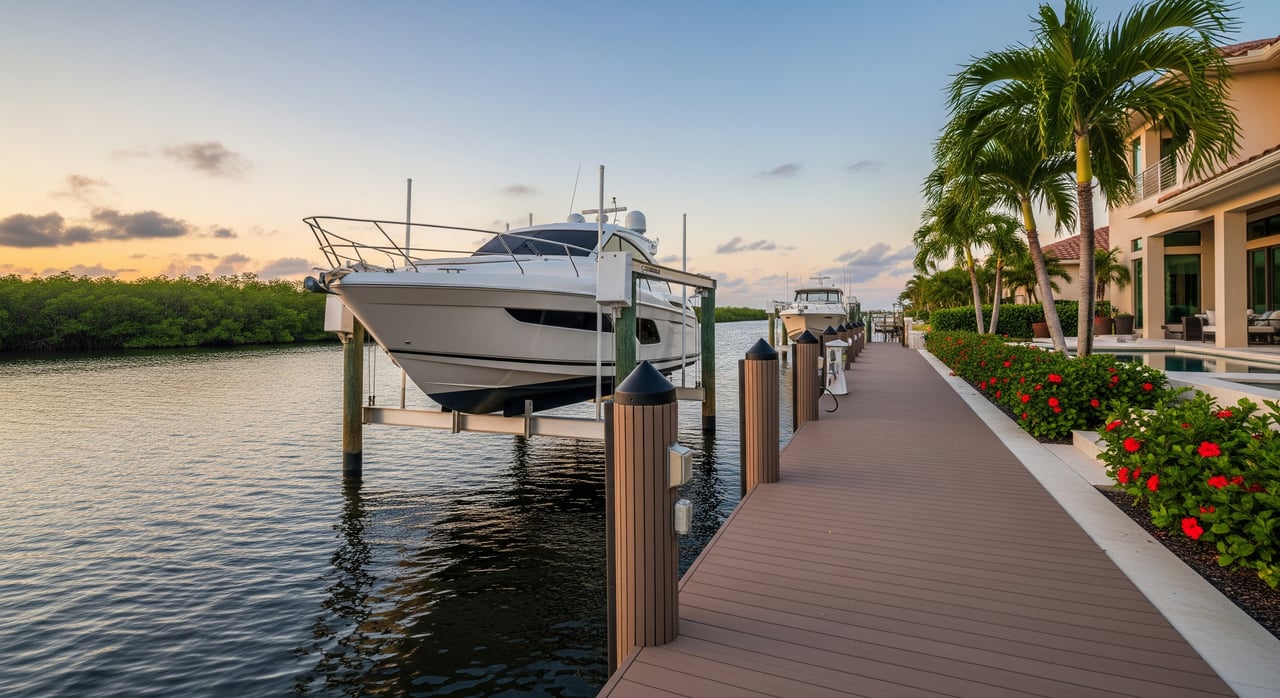
- Boat lifts on pilings or platforms. Capacity, width, and height determine compatibility with towers and hardtops.
- Davits for tenders or personal watercraft.
What to verify before you buy
- Existing permits for docks, lifts, and seawalls. Confirm alignment with city or county standards and hurricane codes.
- Seawall condition and any recent repairs. Seawall work can be a significant capital expense.
- Electrical capacity and condition for lifts and dock lighting. Plan for periodic service.
- Insurance implications for exposed riverfront versus protected canals.
Navigation updates and safety
- Monitor channel changes and navigation warnings in the U.S. Coast Guard Local Notice to Mariners: USCG Local Notice to Mariners
Which fits your boat and lifestyle
Small shallow‑draft boats
- Canal advantage: calm dockage and quick, protected runs. Interior or Gulf‑access canals are comfortable choices.
- Riverfront caveat: workable if depth is adequate, but expect more wake and current at the dock.
Center consoles and offshore boats
- Gulf‑access canals often provide shorter routes to fishing grounds with good day‑use convenience.
- Riverfront can work well for longer runs if you are prepared for wake exposure and potentially longer transits to your favorite spots.
Trawlers, sportfishing yachts, larger powerboats
- Riverfront or marina slips with deeper water and sturdy infrastructure are often preferred. Confirm turning basins and depth along the route.
- Canals can work if maintained and wide enough. Verify dimensions and recent dredging records.
Sailboats
- Depth and bridge clearance are critical. Many sailboats favor riverfront or marina settings near maintained channels.
- Always verify vertical clearances against charts and local guidance.
Daily use vs long passages
- For frequent short trips and quick fishing runs, a shorter route to Matlacha Pass or San Carlos Bay is a major benefit, often found in western or central canals.
- For entertaining with larger vessels or staging longer coastal runs, riverfront bulkheads and turning room can be an advantage.
Quick buyer checklist
Use this list during showings and inspections:
- Channel and dock depth at mean low water. Ask for recent soundings.
- Distance in nautical miles to your preferred pass or anchorage, plus an estimated travel time using your cruise speed.
- Dredging history and who pays for it. Confirm maintenance responsibility.
- Seawall condition, recent inspections, and any pending repair notices.
- Current permits for the dock, lift, and any prior dredging. Confirm code compliance.
- Lift capacity and dimensions, including height for towers or hardtops.
- Any fixed bridges or overhead utilities on your route. Verify vertical clearance on charts.
- Availability of shore power and water, and proximity to fuel, haul out, and service yards.
- Traffic and wake patterns near the property. Note nearby ramps or marinas.
- HOA or local rules on boat size, storage, and dock modifications. Review insurance implications.
Two quick scenarios
You run a 24‑foot bay boat and love dawn trips. A protected Gulf‑access canal with a short route to Matlacha Pass or San Carlos Bay likely gives you calmer dockage and faster launch times. Confirm depth at low tide, lift capacity, and any no‑wake zones near your cut.
You own a 45‑foot trawler and host guests. A riverfront property with robust pilings and a well‑sized turning area can work well if depths are confirmed along your route. Budget for stronger fendering and lines, and verify seawall condition and permits.
Next steps
Before you commit, cross‑check charts and tides, talk with a local captain or marina about current depths, and confirm permits and seawall condition. If you want help aligning the right lot, dock design, and long‑term maintenance plan with your boat and lifestyle, our senior advisors can coordinate permitting insight and builder input so you move forward with clarity. Schedule your consultation with Potter Trinity.
FAQs
Are riverfront lots always better for big boats in Cape Coral?
- Not always. Riverfront can offer deeper water and turning room, but only if the specific site and route have adequate depth and the dock is built for higher wake and current loads.
Are canal docks protected from wakes in Cape Coral?
- Interior canals are generally calmer, but canals near main cuts, ramps, or marinas still see transient wakes, especially on busy weekends.
How do I estimate run time from my dock to open water?
- Divide distance in nautical miles by your cruise speed in knots, then multiply by 60 for minutes. Add time for no‑wake zones, current, and traffic.
What should I check for depth and draft at a Cape Coral property?
- Verify depth at mean low water at your dock and along the route, check for shoaling, and confirm dredging history or maintenance responsibility.
What about sailboats and bridge clearance in Cape Coral routes?
- Many sailboats require specific vertical clearances. Confirm bridge heights and channels on NOAA Nautical Charts and plan your route accordingly.
Who issues local navigation updates I should follow?
- The U.S. Coast Guard publishes Local Notices to Mariners with changes to aids and channels. Review the latest notices here: USCG Local Notice to Mariners